Madison Square Garden hosted one of the UFC’s most consequential nights of the year Saturday, but the biggest lessons from the weekend were not limited to New York.
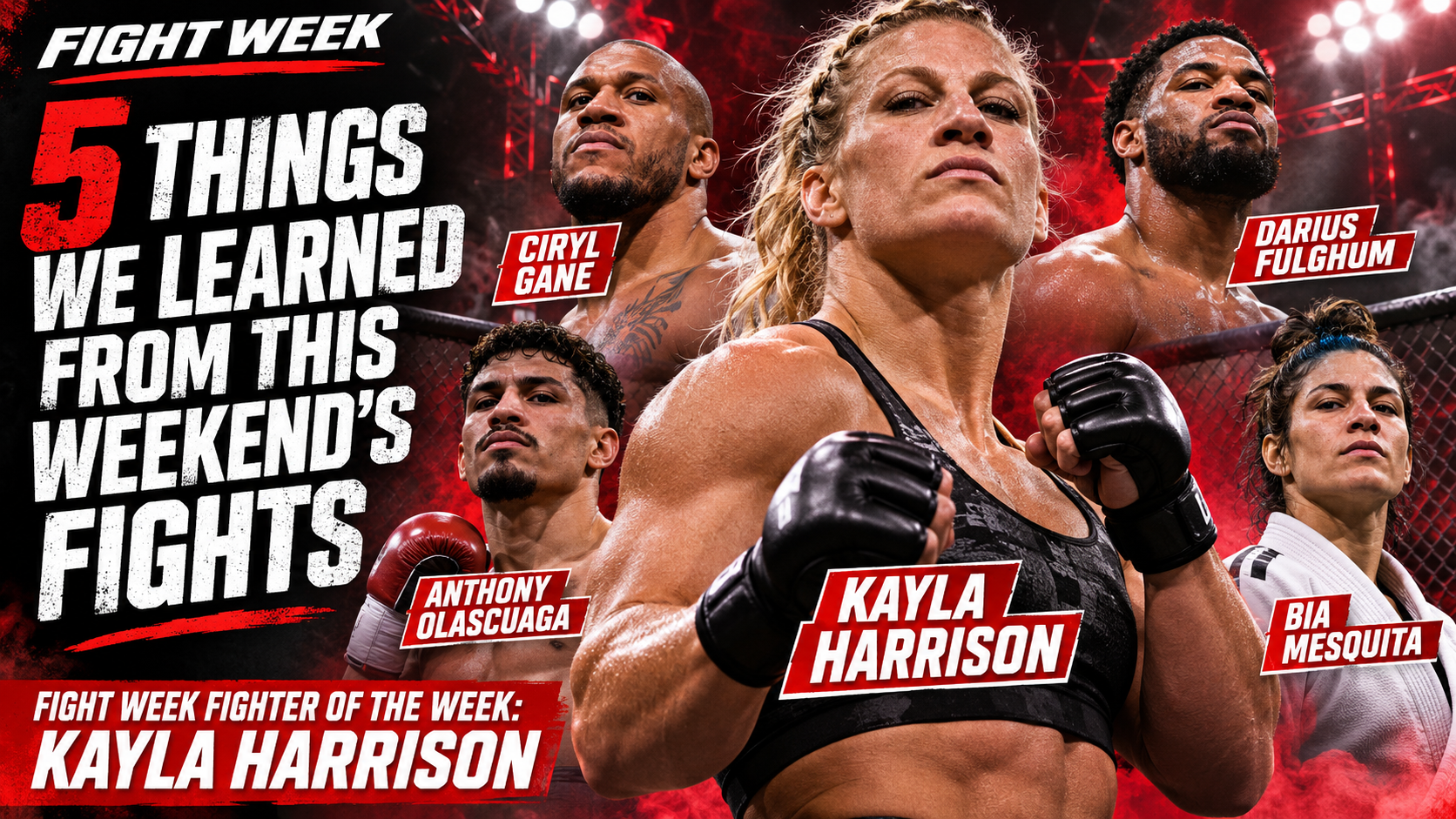
Kayla Harrison answered the biggest question of her championship reign by submitting Amanda Nunes. Ciryl Gane survived a relentless challenge from Josh Hokit and learned that holding the heavyweight championship can be considerably more difficult than winning it. In California, Darius Fulghum walked into Diego Pacheco’s backyard as the underdog and left with a victory capable of completely changing his career, while Anthony Olascuaga had to dig deeper than expected to keep his flyweight championship.
Then there was Bia Mesquita, who needed barely three minutes to make another UFC bantamweight look helpless on the ground and suddenly finds herself much closer to the championship conversation.
This was a weekend that rewarded champions who could adapt and contenders willing to seize opportunities before anyone was ready to give them permission.
Here are five things Fight Week learned from this weekend’s fights.
1. Kayla Harrison Answered the Amanda Nunes Question
There was always going to be an asterisk hanging over Kayla Harrison’s reign until she shared the Octagon with Amanda Nunes.
Harrison could win championships, dominate contenders and build an impressive UFC résumé, but Nunes represented something different. She was the former two-division champion who had defeated almost every major name from the previous generation and retired widely regarded as the greatest female fighter in MMA history.
Saturday night, Harrison did not simply defeat her.
She submitted her.
Harrison retained the UFC women’s bantamweight championship by finishing Nunes with a rear-naked choke in the fourth round at Madison Square Garden. Nunes had returned from nearly three years away specifically for the matchup, but Harrison’s size, wrestling and positional control gradually became the defining factors. She repeatedly put Nunes on her back during the opening rounds before securing another takedown in the fourth, taking the back and forcing the tap.
That matters because Nunes was not just another challenger.
She was the fighter against whom Harrison was always going to be measured.
Harrison’s Olympic judo background and success outside the UFC created years of hypothetical discussion about what would happen if the two ever fought. Saturday removed the hypothetical. Harrison did not need a controversial decision or a fortunate moment to win. She dragged the fight toward the area where she held the greatest advantage and eventually finished one of the most accomplished fighters in MMA history.
There are legitimate questions about what comes next. Harrison acknowledged afterward how difficult the cut to 135 pounds remains, and Nunes must decide whether one comeback fight is enough or whether she wants another opportunity. Those questions can wait.
The most important conclusion is already clear. Harrison’s championship no longer needs validation through someone else’s résumé. What we learned is that Kayla Harrison is not simply carrying the bantamweight belt after the Nunes era. She beat Amanda Nunes and established an era of her own.
2. Ciryl Gane Won — But Josh Hokit Made the Heavyweight Division More Interesting
Ciryl Gane entered UFC 334 as the champion.
Josh Hokit entered as the challenger who supposedly had to prove he belonged in a five-round championship fight.
By the end of Saturday night, Gane still had the belt, but Hokit may have gained almost as much.
Gane retained the UFC heavyweight championship by unanimous decision, winning 48-47 on all three scorecards after five exhausting rounds. The numbers were identical, but the fight itself was anything but comfortable. Hokit pressured relentlessly, mixed takedowns with aggressive boxing and forced Gane into a physical fight that looked nothing like the controlled striking contests the Frenchman typically prefers.
The championship rounds ultimately separated them.
All three judges gave Gane the fourth and fifth rounds after Hokit had built a 29-28 lead through three on every card. As Hokit’s pace began to slow, Gane increased his work to the body, became more effective in the clinch and found enough clean offense to turn the fight in his favor.
That should matter when evaluating both fighters.
Gane deserves credit for adapting. Heavyweights are often criticized for poor conditioning and limited ability to change tactics during a fight, but Gane faced a challenger whose pace created serious problems early and still found a way to take over late. Championship experience mattered.
Hokit, however, may have answered an even bigger question. He was making his first five-round UFC appearance against one of the division’s most technically polished fighters, and for three rounds he was winning the fight. He did not look overwhelmed by the stage or intimidated by the championship.
The temptation after any close title loss is to immediately demand a rematch. There is no need to rush into that yet. Hokit should get another major heavyweight fight, and Gane should continue defending against the strongest available challenger.
But the division gained something Saturday.
It gained a rivalry.
What we learned is that Ciryl Gane remains the heavyweight champion, but Josh Hokit proved he belongs near the very top of the division—and another meeting between them feels more like a possibility than a fantasy.
3. Darius Fulghum Just Changed His Career in Diego Pacheco’s Backyard
For much of the buildup to Saturday’s fight in Carson, California, the conversation centered on Diego Pacheco.
That changed once the bell rang.
Darius Fulghum entered as the betting underdog and left with a unanimous decision victory over the previously unbeaten Pacheco, winning by scores of 115-112 twice and 114-113. The victory improved Fulghum to 16-1-1 and handed Pacheco his first professional defeat.
The significance was not simply that Fulghum won.
It was how he won.
Fulghum pressured from the opening rounds, controlled distance with his jab and repeatedly forced Pacheco into exchanges that were more uncomfortable than the hometown favorite expected. He opened a cut under Pacheco’s right eye in the third round, attacked the body and consistently answered whenever Pacheco appeared ready to seize momentum.
There were difficult moments.
Pacheco hurt Fulghum late in the sixth and again found success during portions of the second half. Fulghum was also deducted a point in the ninth for punches to the back of the head, creating the kind of situation where an underdog can easily allow a major victory to slip away.
He did not.
Instead of becoming cautious after the deduction, Fulghum returned to the jab and pressure that had built his lead. The championship rounds became competitive, but Fulghum had already done enough to make sure the judges could not simply hand the night back to Pacheco.
That is why this victory should immediately change the matchmaking around him.
Fulghum no longer needs to be introduced as the dangerous opponent someone else must get through. He just beat one of the division’s most highly regarded unbeaten fighters in Pacheco’s home market.
For Pacheco, the loss is not catastrophic. He is still young enough to improve, and undefeated records are often treated as far more important than they should be. How he responds will tell us more about his ceiling than another routine victory would have.
For Fulghum, however, there is no reason to move backward.
What we learned is that Darius Fulghum did not score an upset that should be treated as an accident. He outboxed and outworked a legitimate contender for 12 rounds, and the super-middleweight division now has to make room for him.
4. Anthony Olascuaga Can Survive a Bad Night — But He Should Learn From It
Champions eventually encounter nights when everything does not work.
Anthony Olascuaga had one Saturday.
The WBO flyweight champion retained his title with a unanimous decision over Yuberjen Martinez, winning by scores of 115-112 twice and 114-113, but the closeness of those numbers tells the story. Olascuaga was expected to control the fight more comfortably. Instead, Martinez forced him into one of the most difficult fights of his championship run.
The early rounds suggested Olascuaga might eventually take control. His body punching and hand speed caused problems, and he hurt Martinez with a right hand in the second.
Then Martinez adjusted.
The Colombian challenger began pressing more effectively, landed cleaner combinations during the middle rounds and repeatedly frustrated Olascuaga. The champion admitted afterward that he underestimated Martinez and found himself struggling to solve a fighter whose amateur experience and combination punching were considerably more effective than expected.
That admission may be the most useful part of the entire night.
Olascuaga regained control by returning to the body during the later rounds, slowing Martinez enough to make the fight manageable again. Then, with only seconds remaining in the 12th, he landed a right hand that dropped Martinez. The knockdown turned out to be enormously important: without it, one judge’s card would have been even closer.
Those are the nights that test champions.
The best fighters do not always dominate. Sometimes they miscalculate an opponent, lose rounds and discover that the championship is suddenly at risk. The important part is whether they find another solution before the clock runs out.
Olascuaga did.
The mistake would be treating the victory as evidence that nothing needs fixing. Martinez showed that sustained combinations and intelligent pressure can disrupt Olascuaga’s rhythm, and future challengers will study those rounds closely.
What we learned is that Anthony Olascuaga has championship toughness. Now he has to use Saturday’s scare to become a more complete champion.
5. Bia Mesquita Is Moving Toward the Title Picture Faster Than Expected
Bia Mesquita has one problem.
Nobody has shown that they can stop her grappling.
Macy Chiasson became the latest fighter to try Saturday at UFC 334, and the experiment lasted 3 minutes, 23 seconds.
Mesquita took Chiasson down, worked to the back and finished the veteran contender with a rear-naked choke in the first round. The victory improved Mesquita to 9-0 professionally and 4-0 in the UFC, with all four UFC victories coming by submission.
That streak has already placed her in unusual territory.
Mesquita now owns the UFC women’s bantamweight record for submissions, moving ahead of Ronda Rousey, and she became the first woman in UFC history to win four consecutive fights by submission.
Records are useful, but the larger point is how little resistance Mesquita continues to encounter once fights reach the ground.
Chiasson had a significant size advantage and enough UFC experience to understand exactly what Mesquita wanted to do. It did not matter. Once Mesquita established the body lock and began working behind her, the finish looked inevitable.
The obvious concern remains striking.
A world-class grappler can dominate opponents on the ground while still being vulnerable during the time required to get there. Eventually Mesquita will face a contender capable of making her pay heavily for every unsuccessful takedown attempt.
That is exactly why the UFC should give her that opponent now.
At 35 years old, Mesquita does not need a long developmental schedule. Her grappling pedigree is already elite, she is unbeaten in MMA and she has finished every UFC opponent placed in front of her.
Saturday’s championship result also makes her rise more interesting. Kayla Harrison remains champion after submitting Nunes, but the bantamweight division needs challengers. Mesquita is rapidly building an argument that she could become one.
What we learned is that Bia Mesquita has graduated from interesting prospect to legitimate bantamweight contender. The next opponent should tell us whether she is ready for Kayla Harrison.
Fight Week Fighter of the Week: Kayla Harrison
There were several performances worthy of consideration this weekend.
Darius Fulghum produced the biggest boxing upset by defeating Diego Pacheco in Carson. Ciryl Gane survived a five-round challenge that tested every part of his championship experience. Anthony Olascuaga survived an unexpectedly difficult title defense, while Bia Mesquita continued one of the most dominant submission runs anywhere in the UFC.
But Kayla Harrison is the Fight Week Fighter of the Week.
Saturday was not simply another championship defense.
Harrison stepped into Madison Square Garden against Amanda Nunes, a fighter whose résumé had defined the standard for women’s MMA for nearly a decade. Nunes returned from retirement specifically because Harrison’s arrival had created one final question worth answering.
Harrison answered it herself.
She controlled the wrestling exchanges, repeatedly forced Nunes onto her back and finally submitted her with a rear-naked choke in the fourth round. There was no debate about the scorecards, no controversy about the stoppage and no need to explain why she deserved to remain champion.
Harrison still has difficult decisions ahead, particularly concerning whether continuing to make the bantamweight limit is sustainable. None of those decisions change what happened Saturday night.
For years, the dream fight was Kayla Harrison against Amanda Nunes.
They finally fought.
Kayla Harrison won.
And she finished the greatest opponent of her career.
Fight Week Fighter of the Week: Kayla Harrison.