Brendan Allen vs. Christian Leroy Duncan: Fight Week Preview, Tale of the Tape & Keys to Victory
The middleweight division has a way of changing quickly. A fighter can spend years hovering around the rankings, put together three or four strong performances, and suddenly find himself one victory away from the championship conversation.
That is where Brendan Allen and Christian Leroy Duncan find themselves Saturday night.
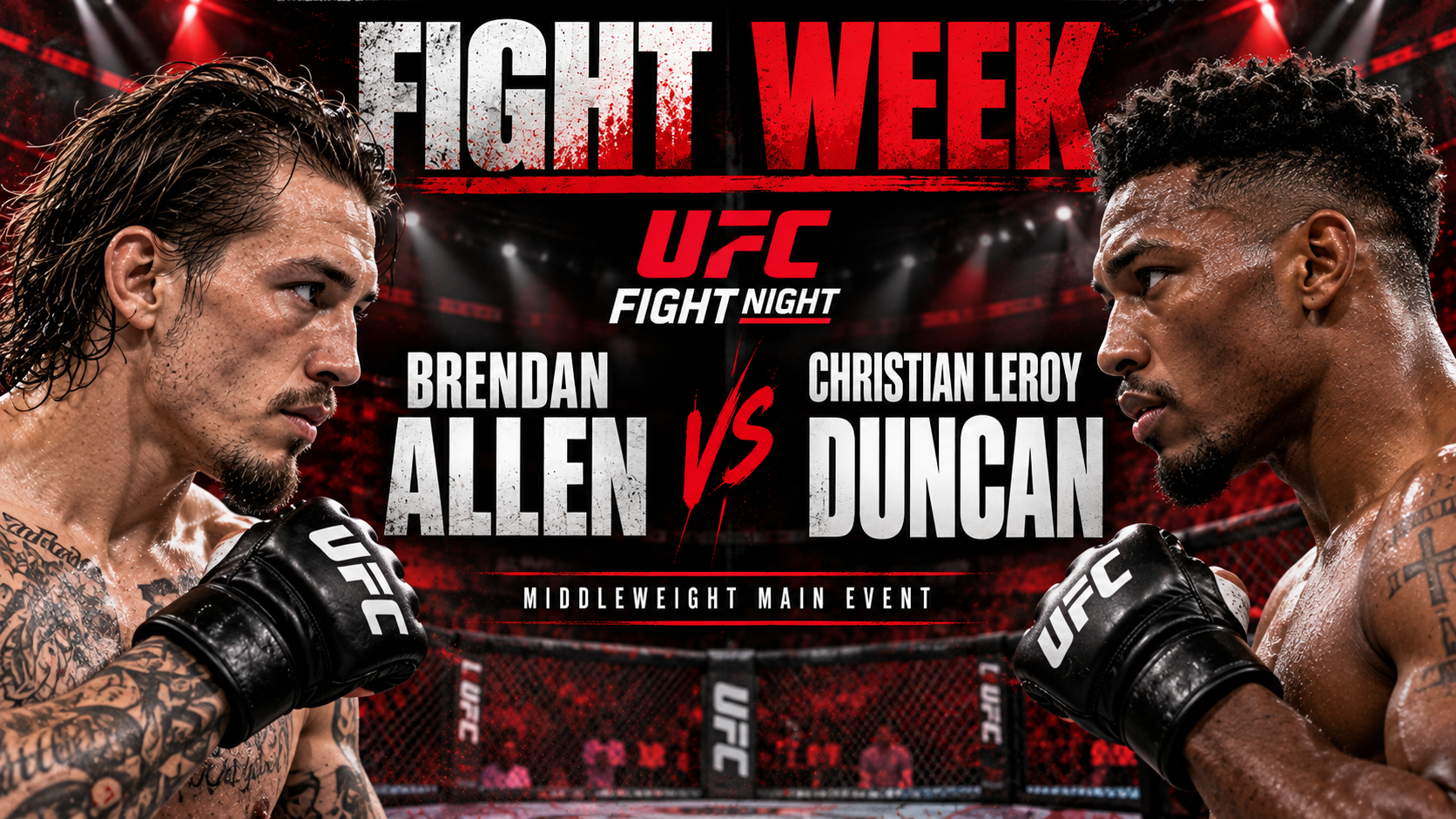
Allen, currently ranked No. 4 at middleweight, meets No. 10-ranked Duncan in the five-round main event of UFC Fight Night at the Meta APEX in Las Vegas. The matchup brings together an established contender trying to force his way toward a title opportunity and one of the division’s fastest-rising fighters looking to announce that his climb through the rankings is ahead of schedule.
There may not be a championship belt sitting beside the Octagon, but the stakes are obvious.
Allen cannot afford to surrender his place near the top of the division to an opponent ranked below him. Duncan, meanwhile, has an opportunity to turn a five-fight winning streak into the biggest victory of his career.
That gives Saturday’s main event exactly what a Fight Week preview should have: two fighters moving in the same direction, but only one likely to leave Las Vegas with his momentum intact.
Tale of the Tape
| Brendan Allen | Christian Leroy Duncan | |
|---|---|---|
| Age | 30 | 31 |
| Height | 6’2″ | 6’2″ |
| Reach | 75″ | 79″ |
| Record | 27-7 | 15-2 |
| KO/TKO Wins | 6 | 10 |
| Submission Wins | 14 | 1 |
| Ranking | No. 4 | No. 10 |
| Stance | Orthodox | Orthodox |
Allen enters with 14 submission victories and six knockouts, while Duncan has built his reputation around striking, recording 10 knockouts in 15 professional victories. Duncan also owns a notable four-inch reach advantage despite the fighters being listed at the same height.
Brendan Allen Has Been Here Before
Allen is only 30 years old, but it sometimes feels as though he has already lived several different UFC careers.
He debuted in the promotion in 2019 and quickly established himself as one of the division’s most dangerous submission threats. There were setbacks — including stoppage losses to Sean Strickland and Chris Curtis — but Allen continued adding pieces to his game. The fighter who once appeared almost completely dependent on creating grappling exchanges has developed into a much more comfortable and composed mixed martial artist.
That evolution is a major reason he enters Saturday on another significant run.
Allen has won three straight and 10 of his last 12 overall. His current streak includes victories over Marvin Vettori, Reinier de Ridder and Edmen Shahbazyan, with the de Ridder victory coming by fourth-round corner stoppage. His most recent win over Shahbazyan in June earned Fight of the Night honors and kept Allen entrenched near the top of the middleweight rankings.
The frustrating part for Allen is that he has been close to breaking through before.
Saturday is another chance to make himself difficult to ignore.
A loss would erase much of the progress he has made during his current streak. A convincing victory over one of the hottest fighters in the division would make his argument considerably stronger.
Why Brendan Allen Can Win
The obvious starting point is the ground game.
Allen is a Brazilian jiu-jitsu black belt with 14 submission victories, including 11 by rear-naked choke. When he gets into dominant grappling positions, he does not simply look to control rounds. He hunts finishes.
That creates an interesting problem for Duncan.
Duncan wants space. He wants enough room to switch attacks, work his kicking game and use the unusual offensive movements that have made him difficult to solve on the feet. Allen’s job will be to remove that space and force Duncan into a fight that requires constant defensive decisions.
The important difference between Allen today and the Allen of several years ago is that he no longer needs the fight to hit the mat immediately.
He can box. He can pressure. He can make an opponent defend strikes before changing levels, and he has become increasingly comfortable allowing a fight to develop rather than forcing his grappling in the opening minutes.
Against Duncan, that patience could be crucial.
If Allen simply shoots from distance, Duncan has enough athleticism to make him pay. If Allen can use his striking to force Duncan toward the fence and turn the exchanges into clinches, the matchup begins to look considerably different.
Keys to Victory for Allen
Allen needs to make Duncan uncomfortable without becoming reckless. The goal should be to steadily shrink the cage, force Duncan to work near the fence and create grappling opportunities naturally rather than chasing takedowns from bad positions.
Once the fight reaches the mat, Allen needs to make those moments count. Duncan has shown improvement in his defensive grappling, but defending Allen for five rounds is a very different assignment. Every scramble presents an opportunity for Allen to find the back, and that remains the position Duncan can least afford to surrender.
Most importantly, Allen should make this a mixed martial arts fight. A clean striking contest at range gives Duncan his best opportunity. Constant transitions between boxing, clinching, wrestling and grappling favor the more experienced all-around fighter.
Christian Leroy Duncan Is No Longer Just a Prospect
At some point, a promising fighter stops being someone to watch for the future.
Duncan has reached that point.
The former Cage Warriors middleweight champion enters Saturday at 15-2 overall and riding a five-fight winning streak. Earlier this year he defeated Roman Dolidze in London before producing the biggest victory of his career in July, when he outworked former UFC title challenger Jared Cannonier over three rounds.
That Cannonier fight mattered.
Veterans like Cannonier are often used to determine whether an emerging contender is genuinely ready for the top of the division. Duncan passed that test and did it without needing the spectacular knockout that had defined much of his earlier career.
He showed patience. He managed distance. He produced consistent offense and stayed composed against an opponent who had spent years competing against the middleweight elite.
Now comes an even more revealing test.
Allen offers a style Duncan has not had to solve at this level. He is younger than Cannonier, comfortable fighting five rounds and capable of making Duncan work in areas where the British contender would probably prefer not to spend extended periods.
If Duncan passes this test too, calling him a rising prospect will no longer make much sense.
He will simply be a contender.
Why Christian Leroy Duncan Can Win
Duncan has the cleaner striking advantage.
He lands 4.45 significant strikes per minute while absorbing only 2.36, and much of his offense comes from the standing position. He is long for the division, athletic and willing to attack with more than just conventional boxing combinations.
That four-inch reach advantage could become particularly important.
Allen is comfortable exchanging strikes, but Duncan should not interpret that as an invitation to meet him in the pocket unnecessarily. His best opportunities will come when he forces Allen to cover distance repeatedly.
The other major factor is confidence.
Five consecutive victories can change a fighter. Duncan has gone from promising newcomer to someone who has now beaten two ranked veterans in the same year. He knows his style works against UFC-level opposition, and the Cannonier victory proved he can win without everything going perfectly.
Saturday is about proving he can do it for five rounds against an opponent with a very different skill set.
Keys to Victory for Duncan
Duncan needs to make the center of the Octagon his territory. If Allen consistently pushes him toward the fence, Duncan will spend too much of the fight defending clinches and takedowns instead of using the weapons that got him here.
His kicks could become especially important. Attacking Allen’s legs and body from range can slow the American’s pressure and make level changes more difficult as the fight progresses.
But none of Duncan’s striking advantages matter if he repeatedly allows Allen to connect his hands around him. Duncan’s takedown defense is officially listed at 58 percent, which makes those early grappling exchanges one of the most important things to watch Saturday night.
If Duncan can stuff Allen’s first few attempts and force him to repeatedly restart from the outside, his confidence — and his striking volume — should grow.
The Fight May Be Decided by Who Controls the Geography
Sometimes the easiest way to understand a matchup is not by asking who has the better striking or grappling.
Ask where each fighter wants to stand.
Duncan wants space behind him and Allen in front of him. From there he can use his reach, footwork and varied striking to make Allen pay for every attempt to close distance.
Allen wants almost the opposite.
He wants Duncan moving toward the fence, where the cage takes away escape routes and turns a four-inch reach disadvantage into something far less important. Once Allen gets his hands connected, the striking numbers suddenly stop mattering.
That battle could begin in the opening minute and continue for as long as the fight lasts.
Duncan does not necessarily have to become the better grappler Saturday.
He simply has to keep Allen from turning the fight into one.
Allen does not need to outstrike Duncan at distance.
He needs to make distance temporary.
That is what makes this matchup much more interesting than the rankings alone suggest.
3 Fighters to Watch
Matheus Camilo
Matheus Camilo is beginning to become one of the more interesting developing fighters at lightweight.
The 25-year-old Brazilian had a difficult UFC debut against Gabe Green, but instead of allowing that loss to define his arrival, he responded with consecutive victories. His most recent performance was particularly impressive, as he stopped Nazim Sadykhov in just 91 seconds in Azerbaijan.
Saturday brings another type of test against veteran British lightweight Jai Herbert.
Herbert is long, experienced and technically sound enough to expose mistakes. That makes this an important measuring-stick fight for Camilo rather than another showcase opportunity. A third consecutive victory would make it increasingly difficult to treat him as just another developing lightweight.
Malcolm Wellmaker
Malcolm Wellmaker has already shown enough power to make people pay attention.
“The Machine” meets Otari Tanzilovi in a bantamweight matchup that should produce plenty of striking exchanges. Wellmaker enters with six knockout victories and six first-round finishes, while Tanzilovi owns seven knockout wins of his own.
For Wellmaker, this is another opportunity to show that the explosiveness that carried him into the UFC can translate as the competition becomes more difficult.
Bantamweight remains one of the deepest divisions in the sport. Moving upward requires more than highlight-reel power, and Saturday should tell us a little more about where Wellmaker fits.
Alice Pereira
Alice Pereira may be the fighter on this card with the most intriguing long-term upside.
The Brazilian is only 20 years old and already owns a 7-1 professional record with five knockouts and one submission. She faces ranked Russian bantamweight Daria Zhelezniakova, who enters at 10-3 and has considerably more professional experience.
That makes this exactly the type of fight young prospects eventually need.
Pereira has already shown physical talent and finishing ability. Saturday is about seeing how those tools hold up against someone who understands the UFC level and has already spent multiple fights dealing with its demands.
A victory could push Pereira into the rankings and make her one of the youngest names worth following in the women’s bantamweight division.
Final Word
Brendan Allen vs. Christian Leroy Duncan does not arrive with the promotional weight of a championship fight, but that does not make the stakes insignificant.
These are the fights that shape divisions before the championship picture becomes obvious.
Allen has spent years building himself into a top-five middleweight. He has been through winning streaks, setbacks and the difficult process of turning a dangerous specialist into a much more complete fighter. At 30, he is entering the stage of his career where simply being highly ranked is no longer enough. He needs victories that force the UFC to give him something bigger.
Duncan is trying to take the spot Allen has spent years earning.
Five consecutive wins have accelerated his rise, and victories over Dolidze and Cannonier showed that he is ready for increasingly difficult assignments. Allen represents the next level — younger than many of the veterans Duncan has recently faced, more dangerous on the ground and considerably closer to a championship opportunity.
One man is trying to protect his place near the front of the line.
The other is trying to skip ahead.
That is what makes Saturday night worth watching.
By the time five rounds are finished — if they need all five — the UFC middleweight division should have a much clearer idea of which man belongs closest to the championship conversation.