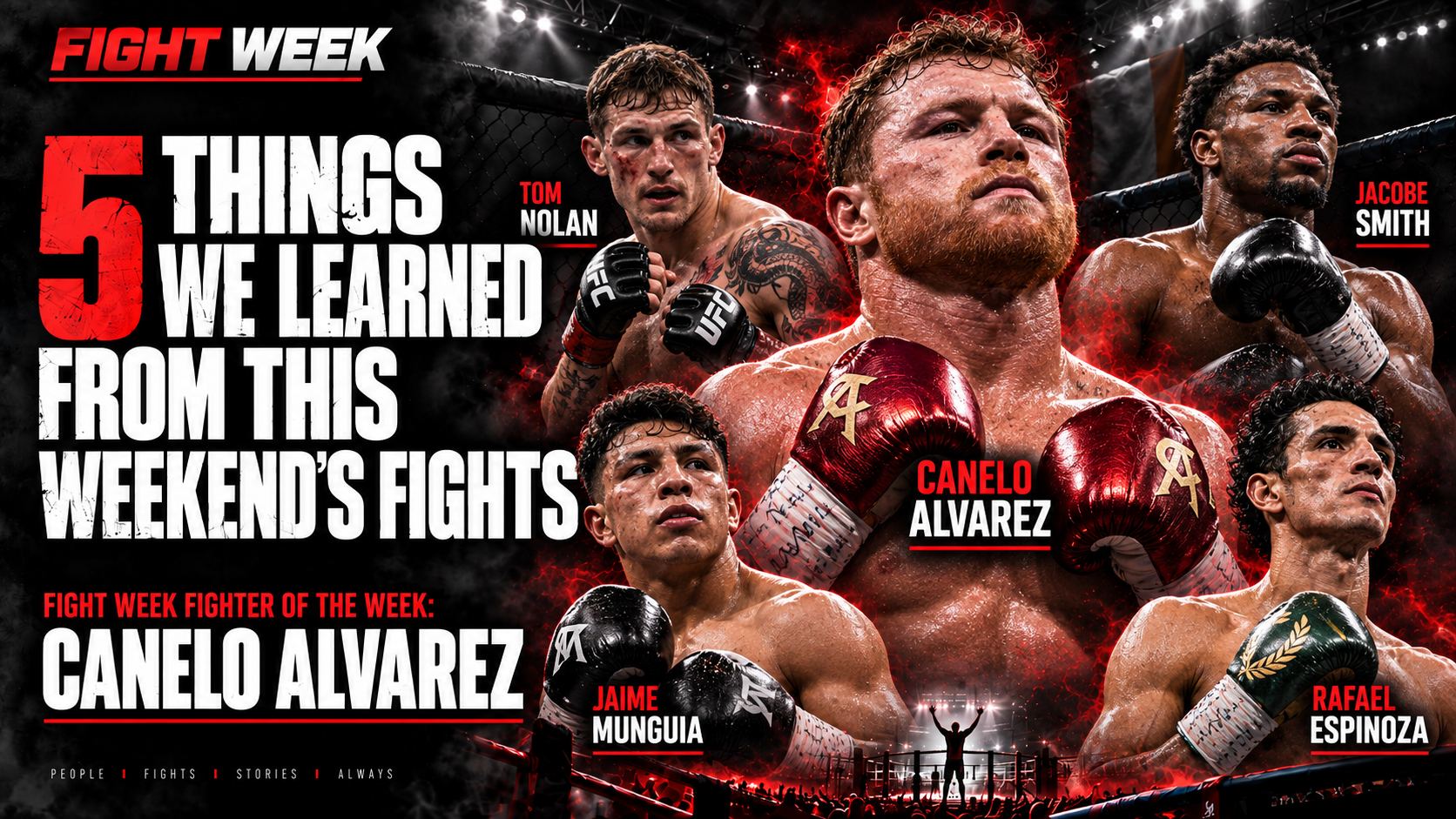
5 Things We Learned From This Weekend’s Fights
Halloween weekend gave combat sports fans something more valuable than a collection of predictable results. It gave us several performances that changed the way we should look at fighters heading into the final two months of 2026.
Canelo Alvarez returned after more than a year away and answered an important question about whether his championship days were behind him. Tom Nolan went from interesting lightweight prospect to legitimate UFC contender by stopping Renato Moicano. Jacobe Smith proved that his unbeaten record deserves to be taken seriously, while Jaime Munguia escaped the kind of fight that exposed both his greatest strength and his most persistent weakness. Rafael Espinoza, meanwhile, made another featherweight title defense look almost routine and again raised the question of why he is not fighting another champion.
There was a little bit of everything: established stars reasserting themselves, young fighters announcing their arrival and champions reaching the point where another routine defense simply is not enough.
Here are five things Fight Week learned from this weekend’s fights.
1. Canelo Alvarez Still Has Championship-Level Boxing Left
It would have been easy to view Saturday as the beginning of Canelo Alvarez’s farewell tour.
He was 36 years old, had not fought in more than a year and was returning from the unanimous-decision loss to Terence Crawford that ended his run as undisputed super middleweight champion. Christian Mbilli, meanwhile, represented the type of opponent who theoretically becomes increasingly dangerous for an aging fighter: younger, physically strong, aggressive and willing to maintain a high work rate.
Canelo responded by reminding everyone why he has remained near the top of boxing for so long.
Alvarez defeated Mbilli by unanimous decision in Riyadh, winning by scores of 115-112, 116-111 and 117-110 to reclaim the WBC super middleweight championship. Mbilli applied pressure and threw punches in volume, but Canelo repeatedly found the cleaner shots, attacked the body and used his counterpunching to take control of the fight. A sharp uppercut in the seventh round briefly staggered Mbilli and provided one of the clearest examples that Canelo still possesses enough timing and power to punish mistakes at the highest level.
That does not mean Saturday somehow erased the Crawford loss or turned the clock backward five years. Canelo is no longer the fighter who needs to defend four belts several times a year to demonstrate his place in the sport. At this point in his career, the question should be less about how frequently he fights and more about whether the fights themselves matter.
What Saturday demonstrated is that Canelo can still beat a younger, unbeaten world-class opponent. Mbilli entered the fight without a professional loss and attempted to force Canelo into the type of physically demanding fight that might expose an aging champion. Instead, Alvarez stayed composed, managed the pace and gradually made Mbilli’s aggression work against him.
The next decision becomes extremely important. Canelo does not need another routine defense simply because a sanctioning body can identify somebody for him to fight. The remaining portion of his career should be about major opponents, meaningful championships and fights that add something to an already historic résumé.
What we learned: The Canelo era is closer to its ending than its beginning, but anyone who thought Terence Crawford had closed the championship chapter of Canelo Alvarez’s career was premature.
2. Tom Nolan Is No Longer a Lightweight Prospect
Tom Nolan walked into his first UFC main event with five consecutive victories and plenty of momentum.
He left with the biggest victory of his career.
Nolan stopped former lightweight title challenger Renato Moicano at 1:28 of the third round, overcoming a difficult opening portion of the fight before taking over with his striking and eventually overwhelming Moicano with ground-and-pound. The victory gave Nolan his sixth straight UFC win and should push him directly into the serious lightweight contender conversation.
The performance was impressive precisely because it was not easy.
Moicano controlled much of the opening round, secured a takedown and spent extended time on Nolan’s back. That is the type of situation where an inexperienced fighter can become impatient, make one bad decision and suddenly find himself caught in a submission. Nolan remained composed, defended the attacks and stayed in the fight.
Once the fight returned to the feet, the momentum changed dramatically. Nolan began finding Moicano with cleaner strikes, hurt him badly with a knee late in the second round and carried that confidence into the third. Even when Moicano attempted another takedown, Nolan reversed position and attacked until the referee stopped the fight.
That sequence may have told us more about Nolan than another first-round knockout would have. UFC lightweights eventually have to deal with opponents who can wrestle, scramble, control positions and force them into uncomfortable situations. Moicano did exactly that.
Nolan solved the problem.
There is no reason to rush directly toward a championship opportunity in perhaps the deepest division in MMA, but there is also very little value in giving Nolan another developmental matchup. He needs another ranked lightweight, preferably someone with enough experience to determine whether Saturday was his breakthrough or simply the beginning of something much bigger.
What we learned: Tom Nolan entered Halloween night as a promising lightweight. He left it as a contender.
3. Jacobe Smith Is Ready for the Rankings
Jacobe Smith did not produce the spectacular knockout some people may have expected.
What he produced might actually be more useful.
Smith dominated veteran Randy Brown over three rounds, earning a unanimous decision with all three judges scoring the fight 30-26. He used his wrestling repeatedly, controlled Brown on the ground and inflicted damage with elbows and ground-and-pound while improving to 5-0 in the UFC.
Until Saturday, most of Smith’s UFC story had been about destruction. Fighters with perfect or nearly perfect finishing records generate attention quickly, but eventually every developing contender reaches the point where somebody refuses to disappear in the first few minutes.
Brown became that opponent.
The important part was that Smith never became frustrated when the finish failed to materialize. He continued attacking the legs, completed takedowns and maintained control instead of abandoning the game plan in search of a highlight.
That is an important development for a fighter expected to compete against ranked welterweights. At higher levels, opponents survive bad positions. They defend submissions. They absorb punches that finished lesser fighters. Winning those fights often requires patience rather than chaos.
Smith demonstrated that patience Saturday.
He mentioned Gabriel Bonfim and Sean Brady afterward, and while the UFC does not necessarily have to give him either specific matchup, the general idea is correct. Smith has reached the point where the next opponent should have a number beside his name—or at least be someone operating immediately outside the rankings.
What we learned: Jacobe Smith does not need another test to determine whether he is a UFC-level welterweight. The next test should determine how close he is to becoming an elite one.
4. Jaime Munguia Survived — But the Same Questions Are Still Following Him
There may not be another high-level boxer who can make winning look quite as dangerous as Jaime Munguia.
Munguia retained his WBA super middleweight championship with a unanimous decision over Nikita Zon, winning by scores of 116-112 and 117-111 twice. On paper, those numbers make the fight appear comfortable.
It was anything but comfortable.
Zon’s awkward southpaw style repeatedly caused problems, and the sixth round became particularly dangerous when he badly hurt Munguia and appeared close to producing a major upset. Munguia survived the attack, fought his way back into the round and eventually took advantage as Zon slowed during the second half of the fight.
There is plenty to admire about that.
Munguia has always had an unusual ability to survive trouble and immediately become dangerous himself. He is physically strong, carries legitimate power and rarely stops believing he can change a fight with offense. Those qualities allowed him to survive Saturday and take control as Zon entered unfamiliar championship rounds.
The concern is that we keep having the same conversation.
Munguia’s offensive instincts make him exciting. His defensive vulnerabilities make almost every opponent more dangerous than expected. Against somebody with elite finishing ability, giving away the openings he gave Zon could produce a dramatically different result.
At 47-2, Munguia is far beyond the point where these can simply be dismissed as mistakes made by a developing fighter. This is part of who he is.
That does not mean he cannot remain a world champion. It means his team must decide whether they can improve the defensive side of his game without removing the aggression that makes Munguia effective in the first place.
The mandatory challenger Bektemir Melikuziev remains in the WBA picture, so Munguia may not have complete freedom over what comes next. Whatever the matchup, however, the lesson from Saturday should be obvious.
What we learned: Jaime Munguia remains dangerous enough to escape trouble, but eventually he will face an opponent who does not let him escape.
5. Rafael Espinoza Needs a Unification Fight
Rafael Espinoza did exactly what a world champion is supposed to do against an overmatched replacement opponent.
He made sure the fight never became interesting.
Espinoza stopped Ricardo Blandon at 1:22 of the third round to make the fifth defense of his WBO featherweight championship and improve to 29-0 with 25 knockouts. His size, reach and offensive variety created problems from the opening round, and a right hand eventually opened a cut over Blandon’s left eye that resulted in the stoppage.
There was some controversy surrounding how quickly the ringside doctor ended the fight, but that really is not the most important part of the story.
Espinoza was originally preparing to face Lorenzo Parra before Blandon entered as a late replacement. He did what was expected, kept his championship and avoided turning an unfortunate matchmaking situation into a disaster.
Now boxing needs to give him something better.
At 6-foot-1, Espinoza remains one of the strangest physical puzzles in boxing. Featherweights are not supposed to possess that type of height and reach, particularly when combined with the willingness to fight aggressively rather than simply stay at long range.
He has already defended his championship five times. Another opponent with little realistic chance of defeating him accomplishes almost nothing.
WBC champion Bruce Carrington and IBF champion Angelo Leo immediately stand out as more meaningful possibilities. Espinoza himself again talked about unification after Saturday’s victory while also mentioning the much bigger prize of eventually facing Naoya Inoue.
The Inoue fight would obviously carry enormous financial appeal if the weight and timing eventually make sense. But Espinoza does not need to wait around hoping boxing’s biggest lower-weight star reaches him.
There are champions available right now.
What we learned: Rafael Espinoza has graduated beyond routine featherweight title defenses. His next meaningful objective should be another championship belt.
Fight Week Fighter of the Week: Canelo Alvarez
Tom Nolan produced the weekend’s biggest UFC breakthrough. Jacobe Smith proved his undefeated record belongs in the welterweight rankings. Rafael Espinoza did exactly what an established champion should do, while Jaime Munguia survived a fight that could easily have become a career-changing disaster.
But Canelo Alvarez is the Fight Week Fighter of the Week.
The significance goes beyond winning another belt.
Canelo entered Saturday night more than a year removed from competition and coming off a clear loss to Terence Crawford. At 36 years old, there was a legitimate question about whether we were watching the transition from Canelo the championship fighter to Canelo the veteran attraction.
Christian Mbilli was exactly the type of opponent capable of answering that question.
He was younger, unbeaten, aggressive and already holding the WBC championship Canelo once owned. Alvarez could not simply show up and rely upon his reputation.
He had to fight like a champion again.
Canelo did exactly that.
He handled Mbilli’s pressure, consistently landed the cleaner punches, attacked the body and showed enough precision and timing to separate himself over 12 rounds. When the scorecards were read, Canelo Alvarez was once again a super middleweight world champion.
Saturday did not prove Canelo is still at his absolute peak.
It proved something more relevant.
He does not have to be at his peak to remain one of the best fighters in the world.
The final stage of Canelo Alvarez’s career is officially underway. If Saturday is any indication, there may still be several important chapters left.
Fight Week Fighter of the Week: Canelo Alvarez.