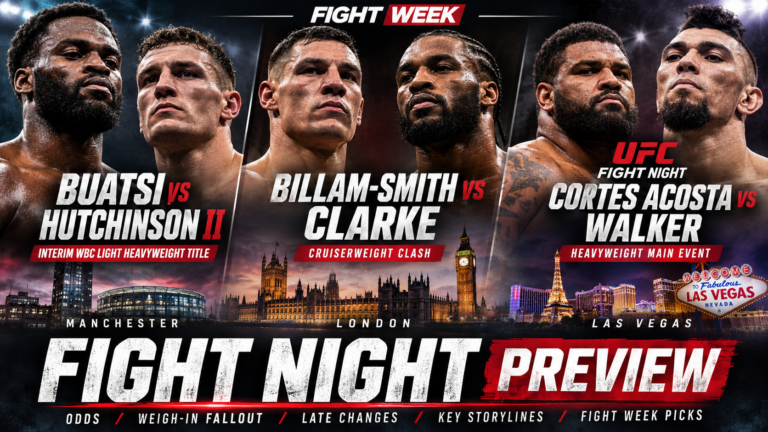
A world championship changed hands in Manchester, an established cruiserweight was stopped in London, and a fighter once known for chaos at light heavyweight suddenly looks like a legitimate problem in the UFC heavyweight division.
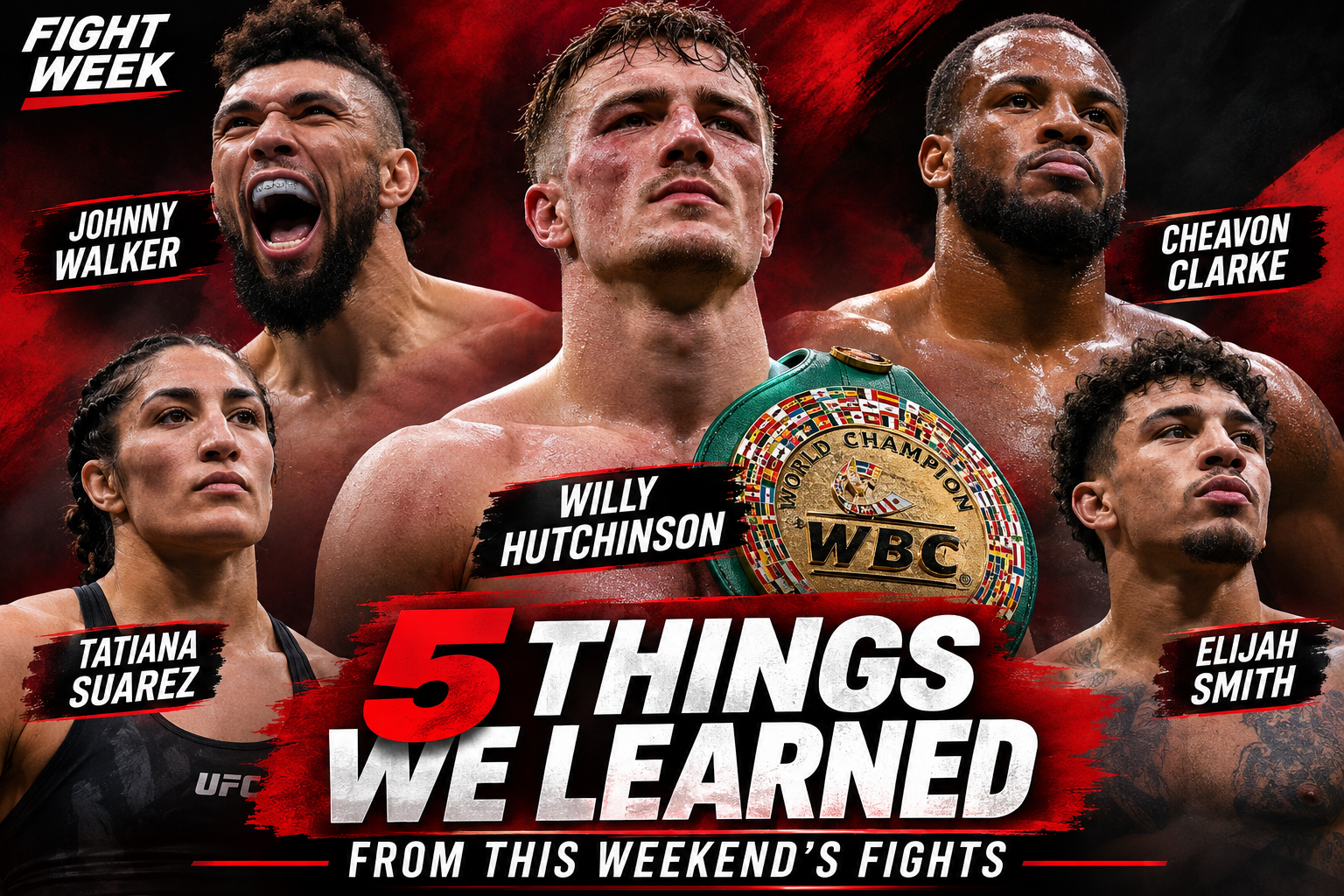
This weekend was less about the sport’s biggest superstars and more about fighters changing the direction of their careers. Willy Hutchinson finally turned potential into a world championship while avenging one of the most frustrating losses of his career. Cheavon Clarke announced himself as a serious cruiserweight contender by doing something nobody expected him to do against Chris Billam-Smith. Johnny Walker continued a heavyweight transformation that suddenly looks far more important than an experiment, while Tatiana Suarez and Elijah Smith used UFC Vegas 124 to make very different arguments about where they belong next.
The names may not have generated the attention of a Canelo Alvarez or Terence Crawford weekend, but several divisions looked different by the time Saturday night ended.
Here are five things Fight Week learned from this weekend’s fights.
1. Willy Hutchinson Finally Turned Talent Into a World Championship
For most of Willy Hutchinson’s professional career, the talent has been obvious. The problem was turning that talent into the kind of complete performance required to win at the highest level.
Saturday night in Manchester, Hutchinson finally did it.
Hutchinson defeated Joshua Buatsi by unanimous decision to capture the vacant WBC light heavyweight championship, winning by scores of 117-112 and 115-113 twice. The result was significant on its own, but the history between the two fighters made it considerably more meaningful. Buatsi had beaten Hutchinson by split decision in their first meeting in 2024, dropping him twice during a physical fight that Hutchinson believed he could have won. This time, he refused to allow the same type of fight to develop.
Hutchinson spent much of the early portion of the rematch using his movement, hand speed and counterpunching to prevent Buatsi from setting his feet. Rather than meeting Buatsi in the type of extended exchanges that had created problems in their first fight, Hutchinson forced him to chase and repeatedly made him reset before attacking.
Buatsi eventually increased the pressure and had considerably more success during the second half of the fight, but Hutchinson had already established enough of a lead to withstand the late charge. He continued finding enough offense from the back foot to prevent the fight from completely slipping away and closed the night with the championship that had eluded him.
There is a larger lesson in the performance. Hutchinson did not win because he suddenly became a different athlete. He won because he fought a more disciplined fight. There was less unnecessary risk and a better understanding of when to engage, when to move and when simply to make Buatsi start over.
That is often the difference between a talented contender and a world champion.
The light heavyweight division now has another interesting name near the top, and Hutchinson’s next challenge will be proving Saturday was not simply the perfect performance against a familiar opponent. Winning a championship changes the expectations. Opponents will prepare differently, mandatory challengers will arrive and the temptation to chase bigger fights will immediately follow.
For now, though, Hutchinson deserves to enjoy what he earned. What we learned is that Willy Hutchinson no longer has to be described as a fighter with championship potential. He is a world champion.
2. Cheavon Clarke Just Changed the Cruiserweight Conversation
Chris Billam-Smith entered Saturday as a former world champion who had already proved he could survive hard fights against high-level opposition.
Cheavon Clarke entered needing a victory that would prove his professional career belonged on the same stage.
Clarke provided a very convincing answer.
He stopped Billam-Smith in the seventh round at London’s Copper Box Arena, producing the kind of victory that can completely change a fighter’s career. Billam-Smith had accomplished more as a professional and possessed significantly more experience in major fights, but Clarke repeatedly found ways to disrupt him before eventually forcing the stoppage.
The result was not completely without precedent. Clarke had defeated Billam-Smith twice during their amateur careers, including in the 2016 national championship final. Professional boxing, however, is an entirely different test, and Billam-Smith had since gone on to win the WBO cruiserweight championship and establish himself as one of Britain’s most reliable high-level fighters.
That is why Saturday matters so much for Clarke.
There is a difference between believing you have another fighter’s number and proving it when the rounds are longer, the gloves are smaller and the stakes are dramatically higher. Clarke did not simply edge Billam-Smith on points or survive a difficult fight. He stopped him.
The victory also forces the cruiserweight division to take Clarke seriously immediately. There is no longer much value in returning him to low-risk developmental fights after defeating an opponent with Billam-Smith’s résumé. He needs another contender who can help determine whether this was a breakout performance or the beginning of a legitimate championship run.
For Billam-Smith, the loss creates a much more difficult conversation. He has been involved in numerous demanding fights, and Saturday showed that his durability cannot always be relied upon to rescue him when an opponent begins finding consistent success.
Clarke, meanwhile, leaves the weekend with something more valuable than another victory on his record. He has a result people will remember. What we learned is that Cheavon Clarke has officially moved beyond prospect territory. Cruiserweight now has another contender that matters.
3. Johnny Walker at Heavyweight Is Starting to Look Very Real
When Johnny Walker announced his move to heavyweight, it was reasonable to wonder whether we were simply watching the latest chapter in one of MMA’s most unpredictable careers.
Two fights later, the move looks considerably more serious.
Walker stopped No. 6-ranked Waldo Cortes-Acosta at 2:27 of the third round in the UFC Vegas 124 main event, securing his second consecutive heavyweight stoppage after knocking out Mick Parkin in October. The UFC itself described Walker as having blasted his way into the heavyweight title picture, and that assessment suddenly does not sound exaggerated.
What made Saturday particularly revealing was that Walker had to survive before he could celebrate.
Cortes-Acosta repeatedly pressured him and landed heavy right hands. He had significant success in the second round, took Walker down and appeared to be wearing down a fighter competing at heavyweight for only the second time. On two judges’ scorecards, Walker was behind entering the third.
Then the entire fight changed.
Walker caught Cortes-Acosta with a head kick, recognized immediately that his opponent was hurt and attacked with the kind of explosive athleticism that has always made him dangerous. A right hand eventually dropped Cortes-Acosta and ended the fight.
The difference is that Walker’s explosiveness now looks different at heavyweight.
At light heavyweight, the conversation often revolved around whether Walker could survive long enough to use his athletic gifts. Cutting to 205 pounds appeared to come with a physical cost, and his chin became one of the first things discussed before almost every fight. Heavyweight does not magically erase defensive mistakes, and Cortes-Acosta proved Walker can still be hit cleanly, but Walker now appears more comfortable physically while maintaining the unusual speed and kicking ability that made him dangerous at a smaller weight.
Heavyweight also gives him something he rarely possessed at light heavyweight: a consistent athletic advantage. He is long, fast and far more varied than many opponents who have spent their careers relying primarily on boxing and power.
We should not rush directly from two victories to declaring Walker the next champion. Heavyweight becomes a very different place when the names begin including the division’s elite. But after consecutive stoppages and a win over a top-six opponent, Walker has earned the opportunity to find out exactly where he belongs.
What we learned is that Johnny Walker’s move to heavyweight is no longer an interesting experiment. It may have revived his career.
4. Tatiana Suarez May Have Forced the UFC’s Hand
Tatiana Suarez did not deliver the weekend’s most entertaining fight.
She may have delivered one of its most important performances.
Suarez defeated Virna Jandiroba by unanimous decision, winning by scores of 30-27, 30-27 and 29-28 in a matchup between two of the UFC’s highest-ranked strawweights. The fight became exactly the kind of grappling-heavy contest many expected, and Suarez gradually imposed herself through wrestling, clinch control and top position.
Jandiroba deserves credit for making Suarez work. She defended numerous early takedown attempts and threatened with submissions when opportunities appeared, including a late kneebar attempt. The difficulty of the matchup actually made Suarez’s performance more useful because it forced her to stay disciplined instead of simply overwhelming an opponent with superior wrestling.
By the third round, Suarez had established the kind of control that has defined much of her best work. She secured another takedown, stayed on top and prevented Jandiroba from creating the scramble she needed to change the fight.
The question now becomes what else the UFC can reasonably ask Suarez to do before putting her back into a championship fight.
She is ranked near the very top of the division, just defeated another elite contender and presents an interesting stylistic matchup with current strawweight champion Mackenzie Dern. Suarez made her intentions clear after the decision: she wants the belt.
There will be understandable hesitation because Suarez’s career has repeatedly been interrupted by injuries, and championship matchmaking rarely comes down to rankings alone. But if title opportunities are supposed to reward victories over elite opponents, Saturday strengthened Suarez’s argument significantly.
She does not need another fight simply to prove that she belongs near the top of the division. We already know that.
What we learned is that Tatiana Suarez has put the UFC in a position where another non-title fight needs a very good justification.
5. Elijah Smith Is Ready to Graduate From Prospect Status
There is a point in every promising fighter’s career when the conversation has to change.
Elijah Smith reached that point Saturday night.
The 24-year-old bantamweight knocked out veteran Davey Grant in just 60 seconds, improving to 4-0 in the UFC and turning what was supposed to be an important step-up test into a remarkably short night. Smith responded to Grant’s early offense with a violent combination, dropped him and forced the referee to intervene almost immediately.
Grant was exactly the kind of opponent a young fighter needs before entering the rankings. He has spent more than a decade competing inside the UFC, has fought numerous styles and possesses enough experience to expose prospects who are not yet ready for the next level.
Smith never allowed that experience to matter.
There is always danger in overreacting to a quick knockout. Sixty seconds cannot tell us everything about Smith’s wrestling, cardio, defensive discipline or how he responds when a ranked opponent refuses to disappear. Those questions still need answers.
But matchmaking is supposed to evolve when fighters keep passing the tests placed in front of them. Smith has now won four UFC fights, and Saturday’s victory came against the most experienced opponent of his career.
There is another interesting wrinkle: Smith revealed afterward that the Grant fight completed his UFC contract, meaning the promotion now has a decision to make about retaining one of the division’s more promising young fighters. Given the performance he just produced, that negotiation should look very different than it might have before Saturday.
Assuming Smith remains with the UFC, the next matchup should tell us whether he belongs in the bantamweight rankings. There is little value in returning him to another opponent designed simply to provide rounds.
What we learned is that Elijah Smith has completed the prospect portion of his UFC career. The next fight should determine whether he is ready to become a contender.
Fight Week Fighter of the Week: Willy Hutchinson
Johnny Walker produced the weekend’s most dramatic comeback and may have discovered the weight class that finally allows him to maximize his physical gifts. Cheavon Clarke scored a major breakthrough against a former cruiserweight champion, Tatiana Suarez strengthened her case for another UFC title opportunity, and Elijah Smith delivered the kind of knockout that can accelerate a young fighter’s career overnight.
But Willy Hutchinson is the Fight Week Fighter of the Week.
The reason is bigger than simply winning another fight.
Hutchinson entered Saturday carrying the memory of a 2024 loss to Joshua Buatsi in which he had enough success to believe he could have won but made enough mistakes to leave without the decision. The rematch offered him something fighters rarely receive in such perfect circumstances: a chance to correct the past with a world championship attached to it.
He did exactly that.
Instead of allowing Buatsi to turn the rematch into another physical battle, Hutchinson used movement and speed to control the early rounds, forced Buatsi to chase him and accumulated enough of a lead to survive the veteran contender’s late push. When the scorecards were announced, Hutchinson had not simply avenged a defeat. He had become the WBC light heavyweight world champion.
Championship victories are often described as career-changing moments, but this one genuinely qualifies. Hutchinson entered the weekend as a talented fighter still trying to prove he could convert ability into an elite-level result. He left with one of boxing’s recognized world championships and a completely different set of possibilities ahead of him.
The challenge now is proving that winning the title was the beginning rather than the destination.
For this weekend, however, nobody changed his career more.
Fight Week Fighter of the Week: Willy Hutchinson.