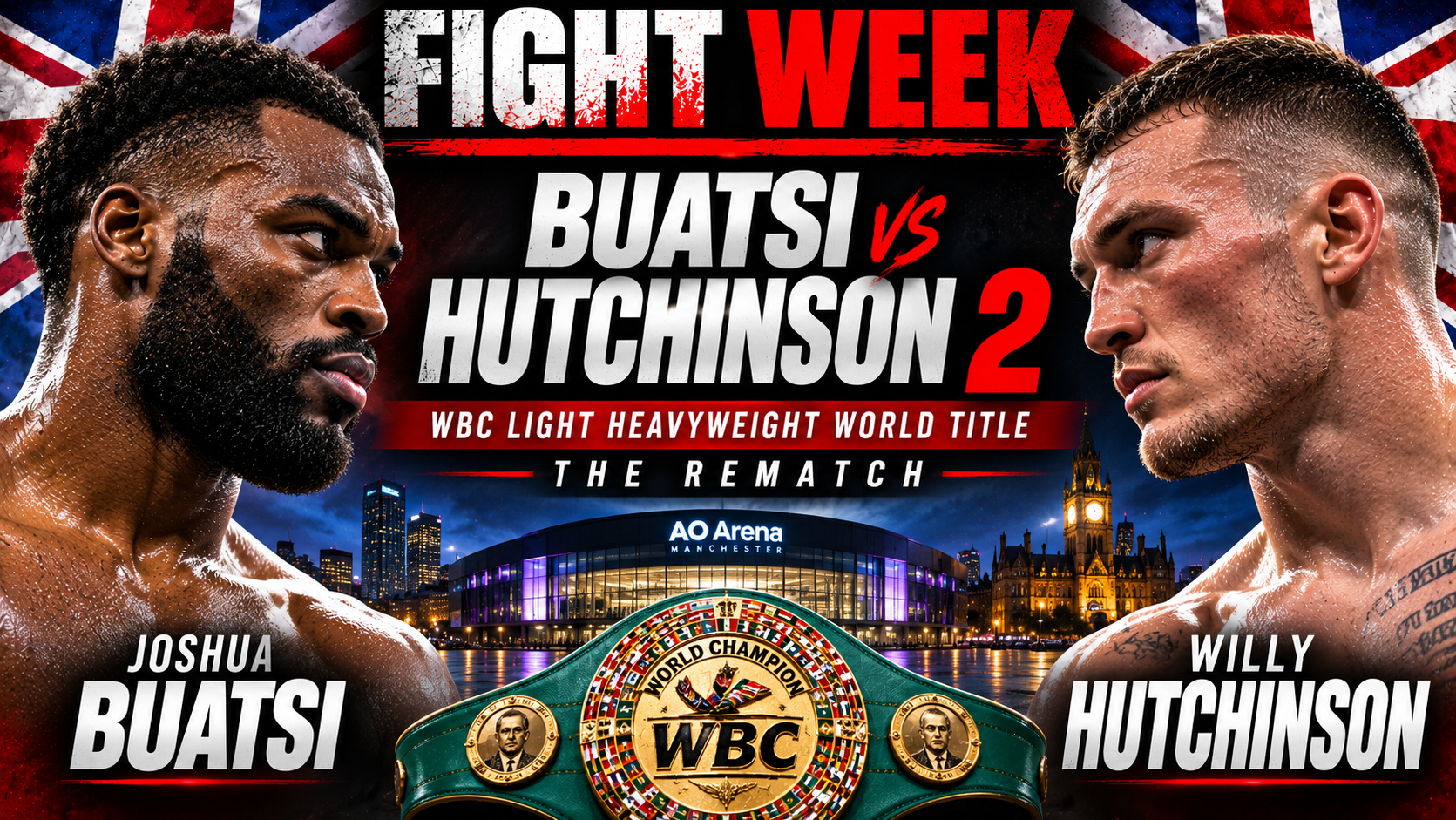
Two years ago, Joshua Buatsi and Willy Hutchinson fought for position in the light heavyweight division. Saturday night in Manchester, they fight for something much bigger.
Buatsi and Hutchinson meet again at the AO Arena with the vacant WBC light heavyweight championship on the line, transforming what might have been another domestic rivalry fight into a matchup that could determine the direction of both careers.
Their first meeting at Wembley Stadium in September 2024 ended with Buatsi winning a split decision after 12 rounds. He dropped Hutchinson twice, once in the sixth and again in the ninth, and those knockdowns ultimately proved crucial. Two judges had Buatsi comfortably ahead, while a third somehow saw Hutchinson winning the fight.
That disagreement has followed the matchup ever since.
Hutchinson has maintained that the first fight never settled the issue. Buatsi has understandably looked at it differently. He knocked Hutchinson down twice, had his hand raised and moved forward with his career.
Now neither man has to argue about it anymore.
They have 12 more rounds — if they need them — and this time someone leaves Manchester as a world champion.
Tale of the Tape
| Joshua Buatsi | Willy Hutchinson | |
|---|---|---|
| Age | 33 | 28 |
| Height | 6’2″ | 6’1″ |
| Record | 20-1 | 20-2 |
| Knockouts | 13 | 14 |
| KO Percentage | 65% | 70% |
| Stance | Orthodox | Orthodox |
| Status | Challenger | Challenger |
Buatsi enters with the advantage in championship-level experience, but Hutchinson is five years younger and has been steadily rebuilding since their first meeting. Both arrive with 20 professional victories, making the rematch less about résumé numbers and more about which man has developed more since Wembley.
The First Fight Still Matters
Rematches are often promoted as completely new fights. Technically, that is true. Fighters change, camps change and the tactical decisions that worked the first time may not work again.
But pretending September 2024 does not matter would be foolish.
Buatsi learned something important that night: he could hurt Hutchinson.
Not once.
Twice.
Hutchinson also learned something important: getting hurt did not mean the fight was over.
He climbed off the canvas both times and continued competing until the final bell. Even though Buatsi earned the decision, Hutchinson never looked like a fighter mentally defeated by what was happening to him.
That resilience is one reason the rematch carries genuine intrigue.
Buatsi has proof that his power and pressure can disrupt Hutchinson.
Hutchinson has proof that he can survive those moments and remain competitive.
The question now is whether either man has discovered something new.
Buatsi Is Fighting for More Than His First World Championship
For years, Joshua Buatsi seemed destined to become a world champion.
The 2016 Olympic bronze medalist entered the professional ranks with enormous expectations and steadily climbed the light heavyweight rankings. He had the athleticism, punching power and amateur pedigree. The question was never whether he belonged among elite fighters. It was whether he would eventually convert all of that potential into a world championship.
Then came Callum Smith.
Buatsi suffered the first defeat of his professional career in February 2025, losing a unanimous decision in a grueling 12-round fight. It was not a collapse or an embarrassing defeat. Buatsi had moments and fought competitively, but Smith was better when it mattered and left with the decision.
Buatsi returned later that year against Zach Parker and won a majority decision, although the performance created almost as many questions as it answered. The bout was cautious, awkward and close enough that some observers believed Parker had done enough.
Even Buatsi acknowledged afterward that it had not been his best performance.
That brings him to Saturday.
At 33, Buatsi is no longer the young prospect everyone assumes will eventually become champion.
Eventually has arrived.
This is the opportunity.
Why Joshua Buatsi Can Win
Buatsi’s advantage begins with his physicality.
He is an excellent athlete who can close distance quickly, work behind a strong jab and produce combinations once he has an opponent moving backward. He does not need to throw enormous volume to control a fight because his punches often carry enough authority to make opponents reconsider exchanges.
That was evident in the first Hutchinson fight.
The knockdowns mattered, but so did the pressure surrounding them. Hutchinson spent portions of the fight boxing effectively from distance, but Buatsi repeatedly found ways to get close enough to turn technical exchanges into physical ones.
That should remain the blueprint.
Buatsi does not need to reinvent himself for the rematch. He needs to take what worked the first time and make it more consistent.
The jab should establish everything. Hutchinson is comfortable when he has room to move, change angles and vary his offense. Buatsi needs to take away that freedom by forcing him backward rather than following him around the ring.
Body punching could become particularly important as well.
Hutchinson is younger and athletic, but making him continually absorb punches downstairs could reduce some of the movement that makes him difficult to pin down.
Most importantly, Buatsi cannot fall into long stretches of inactivity.
That was part of the concern against Parker. A fighter can be landing the harder shots and still allow rounds to become unnecessarily difficult to score if he spends too much time waiting.
Against Hutchinson, that could be dangerous.
Hutchinson Has Spent Two Years Waiting for This
Willy Hutchinson has never been shy about expressing confidence.
That personality helped build interest around the first fight, and it has remained part of the rivalry ever since.
But the most important thing Hutchinson has done since losing to Buatsi is not talk.
He has continued winning.
His most recent significant performance came in March when he defeated previously unbeaten Ezra Taylor by unanimous decision in Manchester. The scorecards — 99-91 and 98-92 twice — reflected a disciplined performance in which Hutchinson increasingly controlled the fight as the rounds progressed.
That version of Hutchinson is probably more dangerous to Buatsi than the one who fought him in 2024.
Hutchinson has always possessed talent. He is long, athletic and capable of changing rhythm in ways that make opponents uncomfortable.
The issue has sometimes been consistency.
He can look excellent for stretches and then allow himself to be drawn into exchanges that do not favor him.
The first Buatsi fight was a good example.
Hutchinson had success boxing.
Then he gave Buatsi opportunities to turn the fight physical.
Saturday will show whether two additional years of experience have taught him how to maintain the discipline required to win a world championship.
Why Willy Hutchinson Can Change the Result
Hutchinson does not need to prove he can survive Buatsi.
He already did that.
What he needs to prove is that he can control him.
The younger fighter’s best route is to make Buatsi continually reset. Hutchinson is at his most effective when he is changing distance, working behind the jab and forcing opponents to reach for him rather than allowing them to comfortably close space.
He should remember the rounds he won the first time rather than obsess over the knockdowns.
Trying to avenge those moments by trading power punches would likely favor Buatsi.
Making Buatsi miss and forcing him to become frustrated could produce a very different fight.
Hutchinson must also be aware of the scorecards.
His confidence in the first fight may have convinced him that he was doing better than the judges believed. Saturday is not the night to assume close rounds are going his way.
If Hutchinson wants the championship, he needs to make his success obvious.
That means clean combinations, visible control of distance and enough activity to prevent Buatsi from stealing rounds with a handful of harder punches.
Five Years Could Matter
The age difference is not enormous.
But it is worth discussing.
Buatsi is 33. Hutchinson is 28.
For a light heavyweight, 33 is hardly ancient, and Buatsi has not accumulated the kind of professional mileage that automatically suggests decline. Still, the difference becomes relevant because Hutchinson’s style relies heavily on movement and athleticism.
He should be entering his physical prime.
Buatsi, meanwhile, has reached the stage where career opportunities become increasingly valuable.
A loss Saturday would not necessarily end his career, but rebuilding toward another world-title opportunity at 34 or 35 would be considerably more difficult.
Hutchinson has more time.
Buatsi has more urgency.
Sometimes that urgency produces a fighter’s best performance.
Sometimes it becomes pressure.
The Division Has Opened a Door
The stakes became considerably larger when David Benavidez moved toward the cruiserweight division and vacated the WBC light heavyweight championship.
That created an opportunity.
Buatsi and Hutchinson are not fighting for an interim belt or simply for another ranking position. The latest WBC announcements identify Saturday’s matchup as being for the vacant WBC light heavyweight world championship.
That matters in a division that has been dominated in recent years by fighters such as Dmitry Bivol, Artur Beterbiev and Benavidez.
A new champion creates new possibilities.
The winner does not simply collect a belt.
He becomes part of every major conversation at 175 pounds.
For Buatsi, that would finally deliver the championship that has been expected of him for most of his professional career.
For Hutchinson, it would transform the result of their first meeting into little more than the opening chapter.
Three Undercard Fighters to Watch
Jack Rafferty
Jack Rafferty has quietly built one of the stronger records on the Manchester boxing scene, and Saturday gives him another opportunity to move forward when he faces Hovhannes Martirosyan.
The bout is scheduled for 12 rounds with the vacant IBO welterweight championship at stake, giving Rafferty an opportunity to add another belt while fighting underneath a major British world-title main event.
Rafferty’s appeal comes from his willingness to engage rather than simply protect an undefeated record. As his opposition improves, those instincts will continue to be tested.
Saturday should tell us whether he is ready to begin pushing beyond the domestic level.
Zak Miller
Zak Miller faces Gully Powar for the vacant British featherweight championship in another fight that deserves attention.
British title fights frequently become some of the most competitive bouts on domestic cards because neither fighter is being positioned simply as an opponent. Both arrive believing the fight represents a genuine step forward.
That makes Miller-Powar considerably more meaningful than a traditional undercard showcase.
The winner leaves Manchester with a recognizable championship and a clear route toward bigger fights in one of boxing’s deepest lower-weight divisions.
Bradley Rea
Bradley Rea faces Ezra Taylor in a light heavyweight matchup that fits perfectly underneath Buatsi-Hutchinson.
Taylor is coming off the first loss of his career after Hutchinson outpointed him in March. Now he gets an immediate opportunity to rebuild against Rea, another British light heavyweight trying to create his own path toward the upper levels of the division.
With the main event determining a new WBC champion, fights like Rea-Taylor matter because they help establish who could eventually join that conversation.
Final Word
Joshua Buatsi and Willy Hutchinson no longer need to argue about what happened the first time.
The scorecards exist.
The knockdowns exist.
Buatsi won.
But Saturday is not about rewriting 2024.
It is about deciding what happens next.
Buatsi enters knowing that opportunities like this do not arrive forever. For years he carried the label of future world champion. At 33, the future has become the present, and the belt he has spent his professional career chasing is finally sitting within reach.
Hutchinson enters with a different kind of motivation.
He has lived with the first defeat to Buatsi for more than two years. He knows exactly where that fight went wrong, knows he survived Buatsi’s biggest moments and believes the fighter returning to the ring Saturday is better than the one who left Wembley without the decision.
There is familiarity between them now.
There is also history.
And unlike the first fight, there will be no need to ask what the winner earns next.
Saturday night in Manchester, Joshua Buatsi and Willy Hutchinson begin Round 13 of their rivalry — and one of them finishes it as WBC light heavyweight champion of the world.