For most fighters, losing a championship fight creates a rebuilding period.
Jiří Procházka has never seemed especially interested in doing things the conventional way.
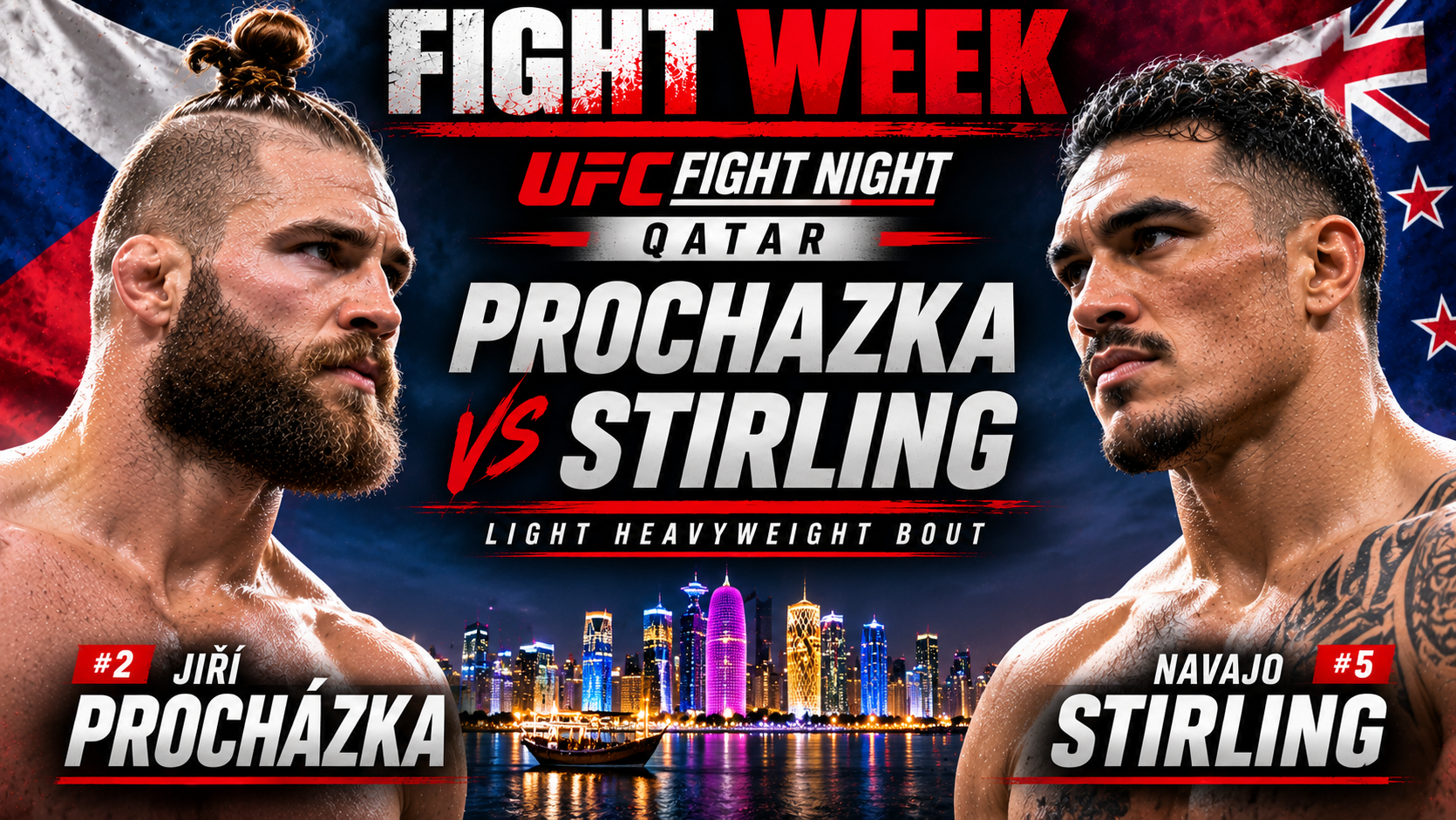
Seven months after Carlos Ulberg knocked him out in the opening round of their fight for the vacant UFC light heavyweight championship, Procházka returns Saturday in Doha against another dangerous New Zealander from the same gym. This time it is undefeated Navajo Stirling, one of the fastest-rising contenders in the division and a fighter whose climb has accelerated dramatically over the last eight months.
The matchup headlines UFC Fight Night at ABHA Arena in Qatar, but the stakes reach well beyond another main event.
Procházka is still ranked No. 2 in the division. Stirling has climbed to No. 5 after stopping three consecutive opponents this year, including former champion Jan Błachowicz. Sitting above both men is Ulberg, Stirling’s City Kickboxing teammate and the man who ended Procházka’s most recent attempt to reclaim UFC gold.
That gives Saturday’s fight an unusual dynamic.
Procházka is not simply trying to beat another contender.
He is trying to stop the same team from reshaping the division around him twice in the same year.
Tale of the Tape
| Jiří Procházka | Navajo Stirling | |
|---|---|---|
| Age | 34 | 29 |
| Height | 6’3″ | 6’4″ |
| Reach | 80″ | 79″ |
| Record | 32-6-1 | 11-0 |
| KO Wins | 28 | 7 |
| Submission Wins | 3 | 0 |
| Ranking | No. 2 | No. 5 |
| Style | Karate / Unorthodox Striking | Kickboxing |
The physical matchup is remarkably even. Stirling is one inch taller, while Procházka owns a one-inch reach advantage. The real difference is experience. Procházka has nearly 40 professional fights and has already competed repeatedly at UFC championship level. Stirling has only 11 professional MMA bouts and made his UFC debut less than two years ago.
Procházka Has Reached a Different Stage of His Career
It feels strange to describe Jiří Procházka as a veteran trying to protect his position because his fighting style has never felt old.
He still fights with the unpredictability of someone improvising in real time. His hands move from unusual positions, his stance changes constantly and his willingness to create chaos has always been part of what makes him compelling.
But the circumstances around him have changed.
Procházka has already reached the top of the division, winning the UFC light heavyweight championship before injuries interrupted his reign. Since returning, his championship opportunities have been increasingly unforgiving.
His April fight with Ulberg demonstrated that clearly.
Procházka appeared to have Ulberg compromised early after the New Zealander appeared to injure his leg. Instead of collapsing, Ulberg remained composed and caught Procházka with a perfectly timed left hook before finishing the fight at 3:45 of the opening round.
It was another reminder of the danger built into Procházka’s style.
His unpredictability can overwhelm opponents.
It can also create openings.
At 34, Saturday is less about whether Procházka remains entertaining and more about whether his approach can still consistently defeat the new generation arriving behind him.
Why Jiří Procházka Can Win
There is an understandable tendency to focus on Procházka’s defensive vulnerabilities because they are impossible to ignore. He fights with his hands low, willingly enters dangerous exchanges and sometimes appears almost intentionally comfortable in situations other elite fighters spend entire camps trying to avoid.
But concentrating only on those weaknesses misses why the style has been so successful.
Procházka is incredibly difficult to prepare for.
Traditional striking defenses are built around recognizable patterns. A fighter knows where the jab usually comes from, how combinations typically flow and what positions an opponent should occupy before attacking.
Procházka breaks those expectations.
He can attack from awkward angles, switch rhythm in the middle of an exchange and throw combinations that look technically irresponsible until they land.
The power is also very real.
Twenty-eight of Procházka’s 32 professional victories have come by knockout. UFC lists 23 first-round finishes on his résumé, giving him the kind of finishing history that forces opponents to remain disciplined from the opening seconds.
That experience should matter against Stirling.
The younger fighter may be undefeated, but he has never shared the Octagon with anyone who creates the kind of uncertainty Procházka does. Błachowicz was a significant test, but Procházka brings a completely different type of threat.
If the former champion can force Stirling into reacting rather than building his offense, the experience gap may become increasingly visible.
What Procházka Needs to Change
The most important adjustment may also be the least dramatic.
Procházka does not need more chaos.
He needs better control of it.
His loss to Ulberg came after he pressed forward against an opponent who was clearly hurt but still dangerous. Procházka saw an opportunity and attacked. Ulberg stayed composed long enough to find the counter that ended the fight.
Against Stirling, patience could be more valuable than aggression.
The New Zealander has shown legitimate counterpunching ability and is coming off three consecutive knockout victories. Giving him predictable entries would turn one of Procházka’s greatest strengths — pressure — into an opportunity for Stirling.
Procházka should still be himself.
Trying to transform into a conservative point fighter would remove too much of what makes him effective. But there is a difference between unpredictability and unnecessary exposure.
If he can maintain the former while reducing the latter, he remains one of the hardest light heavyweights in the world to solve.
Stirling’s Rise Has Happened Very Quickly
Navajo Stirling entered 2026 as an interesting unbeaten prospect.
He enters November looking like a potential title challenger.
That transformation happened in three fights.
Stirling began the year by stopping Bruno Lopes in the second round. Three months later, he stopped Ion Cutelaba, overcoming an early guillotine threat before taking control and finishing him in Round 2. Then came the opportunity that changed his standing completely.
Former champion Jan Błachowicz.
Stirling accepted the fight on relatively short notice and initially found himself hurt. Instead of panicking, he recovered, landed a clean right hand and finished Błachowicz less than three minutes into the opening round.
Suddenly the prospect was ranked inside the top five.
Saturday is the next test.
Beating Błachowicz proved Stirling could defeat an experienced former champion.
Beating Procházka would establish that he belongs among the very best fighters in the division right now.
Why Navajo Stirling Can Win
Stirling may have only 11 professional MMA fights, but his striking background gives him considerably more combat experience than that number suggests.
He competed extensively in kickboxing and Muay Thai before focusing on MMA, and that foundation is increasingly obvious.
Early in his UFC career, Stirling was willing to win decisions while learning how to manage the different demands of the sport. All three of his first UFC fights went to the scorecards.
That has changed dramatically.
His three fights in 2026 have all ended by knockout.
The most encouraging part is that the finishes have not all looked the same.
Against Cutelaba, Stirling had to survive adversity before taking over. Against Błachowicz, he showed the ability to recover after being hurt and immediately identify an opportunity to counter.
Those experiences matter against Procházka.
Stirling cannot expect a clean technical kickboxing match. Procházka is going to create strange exchanges and awkward moments. The young contender’s ability to remain calm when the fight stops looking familiar may determine everything.
City Kickboxing also gives him another obvious advantage.
His teammate just fought Procházka seven months ago.
Ulberg did not simply defeat him. He spent an entire training camp studying him and then found the opening that produced a first-round knockout.
There is no guarantee the same information works twice.
But Stirling is starting with a level of familiarity few opponents could have.
The City Kickboxing Story Cannot Be Ignored
The most interesting subplot surrounding this fight may not involve Stirling alone.
Carlos Ulberg is the UFC light heavyweight champion.
Navajo Stirling is his teammate.
That creates an unusual championship picture if Stirling wins Saturday.
Normally, defeating the No. 2-ranked contender while sitting at No. 5 would create an obvious argument for a future title opportunity.
But Stirling has already acknowledged that fighting Ulberg would be complicated because of their relationship at City Kickboxing. UFC’s own preview notes that it is difficult to imagine the teammates eagerly pursuing a fight against one another.
That does not reduce the stakes.
It makes them more interesting.
Stirling could become one of the highest-ranked fighters in the division without having a straightforward route toward the championship.
For Procházka, the situation is simpler.
A win over Stirling would immediately put him back into the conversation surrounding Ulberg’s title, especially given his ranking and history in the division.
Saturday could therefore shape the championship picture even if the winner’s next move remains uncertain.
Experience Against Momentum
This is ultimately what makes the matchup compelling.
Procházka owns the résumé.
Stirling owns the momentum.
Procházka has fought championship rounds, experienced massive UFC main events and shared the Octagon with some of the division’s best fighters.
Stirling has never lost.
He has also never experienced a five-round UFC main event.
Those facts will not matter equally throughout the fight.
Early, Stirling’s youth, speed and technical discipline may be more important.
If the fight stretches into Rounds 4 and 5, Procházka’s experience in chaos could become much more valuable.
The longer Stirling remains composed, the more convincing his rise becomes.
The longer Procházka keeps forcing him into uncomfortable situations, the more questions the undefeated contender will have to answer for the first time.
Three Other Fighters to Watch in Qatar
Kevin Vallejos
Kevin Vallejos may be one of the most important fighters on the entire card outside the main event.
The Argentine featherweight has climbed to No. 9 after winning his first four UFC appearances, with recent finishes over Giga Chikadze and Josh Emmett accelerating his rise. Saturday he faces former bantamweight champion and current No. 4-ranked featherweight Aljamain Sterling.
This is the classic prospect-versus-veteran test.
Vallejos has the offensive momentum. Sterling brings elite wrestling, championship experience and the ability to force opponents into fights they may not want.
If Vallejos passes this test, the featherweight title conversation heading into 2027 becomes significantly more crowded.
Dan Hooker
Dan Hooker remains one of the most reliable action fighters in the UFC, and Saturday gives him another unusual challenge when Brian Ortega moves to lightweight.
Hooker has spent years competing against elite opposition at 155 pounds and has built his reputation around toughness, pressure and a willingness to stay in dangerous exchanges longer than most fighters would consider reasonable.
Ortega brings a very different threat.
His submission game remains dangerous regardless of division, and moving to lightweight removes the difficult cut to 145 pounds that has defined much of his UFC career. The stylistic contrast — Hooker’s striking and durability against Ortega’s grappling instincts — makes this far more than a novelty matchup.
Kyoji Horiguchi
Kyoji Horiguchi has been competing at an elite level across multiple organizations for more than a decade, and his current UFC run has placed him back inside the flyweight top five.
Saturday he faces No. 7-ranked Asu Almabayev in a fight with real implications for a division currently ruled by Joshua Van.
Horiguchi’s movement, timing and experience remain exceptional, but Almabayev has won seven of his eight UFC appearances and brings the kind of wrestling-heavy pressure capable of forcing veterans into difficult fights.
For Horiguchi, this is another opportunity to show that his return to the UFC is not simply a nostalgia story.
He remains a legitimate contender.
Final Word
Jiří Procházka has spent most of his career making normal fights look strange.
Navajo Stirling has spent the last year making increasingly difficult fights look surprisingly manageable.
Saturday brings those two trajectories together.
For Procházka, this is about proving that one knockout loss did not remove him from the championship level. He remains ranked No. 2, remains one of the most dangerous finishers in the division and remains capable of turning almost any exchange into something nobody expected.
But the division is changing around him.
Carlos Ulberg already took the championship.
Now Ulberg’s teammate is trying to take Procházka’s place near the front of the line.
Stirling enters unbeaten, increasingly confident and coming off the biggest victory of his career. Eleven fights into his professional MMA career, he is already headlining against a former UFC champion.
That rise has been remarkably fast.
Saturday tells us whether it has also been real enough to survive Jiří Procházka.
For one man, Qatar is an opportunity to reclaim momentum.
For the other, it is the night a prospect can become a genuine championship-level contender.
And at light heavyweight, where one clean punch can change everything before a storyline has time to develop, that makes this exactly the kind of fight worth building a weekend around.